
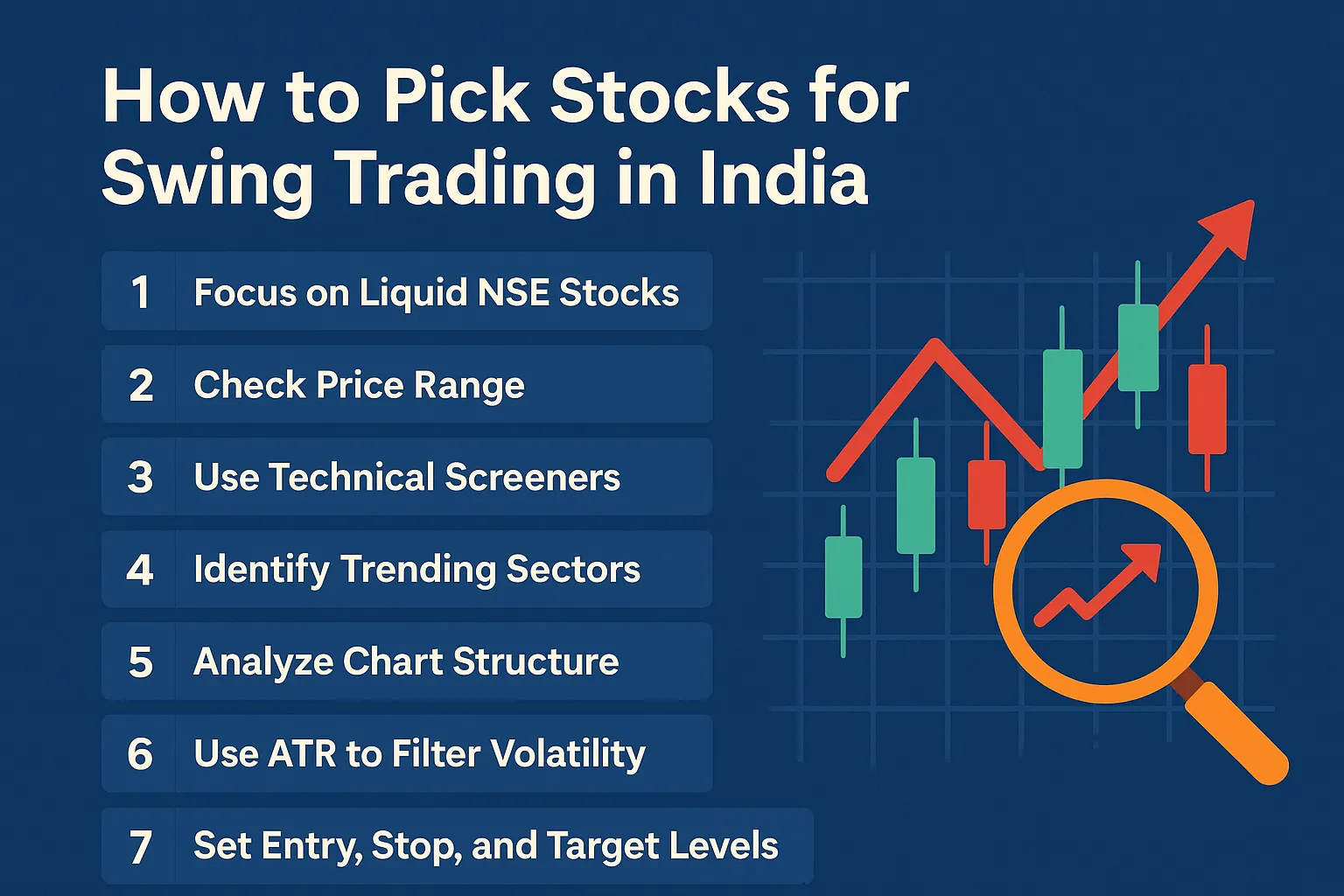
How to Pick Stocks for Swing Trading in India
Swing trading is one of the most practical and popular trading styles for Indian retail traders. It allows you to capture medium-term price moves — usually holding trades for a few days to a few weeks. But the real edge comes from picking the right stocks.
In this guide, you’ll learn exactly how to pick swing trading stocks in India, with a simple and repeatable process.
Why Stock Selection Matters in Swing Trading
A great swing trading setup won’t work if the stock is illiquid, volatile, or fundamentally weak. The right stock will:
- Show predictable price action
- Offer strong trends or breakout potential
- Have sufficient liquidity and volume
- Align with your risk-reward criteria
Step-by-Step: How to Pick Stocks for Swing Trading in India
1. Focus on Liquid NSE Stocks
Start by filtering stocks from:
- Nifty 50
- Nifty Next 50
- Nifty Midcap 100
- Nifty Smallcap 100
These stocks have:
- Higher volumes
- Better price movement
- Less slippage during entry/exit
2. Check Price Range
For retail traders, ideal swing stocks:
- Trade between ₹200 – ₹2000
- Are not too volatile like penny stocks or ultra-high-value stocks
- Allow good position sizing for small capital
3. Use Technical Screeners
Use tools like:
- Chartink.com – For RSI, EMA, MACD, Volume Breakouts
- TradingView Screener – Custom filters, watchlists
- Tickertape & Moneycontrol – For volume and sector heatmaps
Common filters:
- Close above 50 EMA or 200 EMA
- High volume breakout candles
- RSI between 40–60 (pre-breakout zone)
- MACD crossover near zero line
4. Identify Trending Sectors
Swing trading works best in trending sectors. Use NSE heatmaps or sector performance tools to find:
- Leading sectors (e.g., Auto, Banking, FMCG)
- Rotating momentum into new sectors
Stick to stocks within strong-performing sectors to increase trade conviction.
5. Analyze Chart Structure
Ideal technical structures for swing trades include:
- Higher Highs & Higher Lows
- Bullish Flags or Pennants
- Cup and Handle
- Breakout above Resistance with volume
- Support bounce + bullish confirmation
Avoid choppy or sideways charts.
6. Use ATR to Filter Volatility
The Average True Range (ATR) helps you avoid stocks with wild price swings.
Look for:
- Moderate ATR relative to price
- ATR between 2%–4% of stock price (daily)
7. Set Entry, Stop, and Target Levels
Once you shortlist a stock:
- Define your entry near breakout or bounce levels
- Use ATR or chart support to place stop-loss
- Aim for a Risk:Reward of at least 1:2
Example: Swing Trade Stock Selection
- Stock: Titan
- Chart: Uptrend, higher lows, price above 50 EMA
- Volume: Rising on green candles
- Pattern: Ascending triangle forming
- Entry: Above breakout candle
- Stop: Below breakout zone
- Target: Next resistance + measured move
Final Thoughts
Picking the right stocks is the first step toward swing trading success. Don’t chase random tips or news-based hype. Instead, stick to liquid, trending, and technically clean stocks with strong volume behavior.
With discipline and proper scanning, you’ll find 1–3 high-probability swing trades every week — which is more than enough for consistent gains.
FAQs
How many stocks should I swing trade at once?
Begin with 1–2 positions. Advanced traders can manage 3–5 based on capital and strategy.
Are smallcap stocks good for swing trading?
Yes, but only if they’re liquid and technically strong. Use caution due to higher volatility.
Should I swing trade based on news?
Avoid it. News-based moves are often short-lived. Focus on technical setups and structure.
Can I use fundamental analysis to pick swing stocks?
Fundamentals can help, but technical patterns and price action are more important in swing trading.
Which is better for swing trading: TradingView or Chartink?
Both are good. Use Chartink for scanning and TradingView for charting and alerts.